
In the world of IT outsourcing, employee retention is a problem faced by both service providers and their Clients. The former risk losing new jobs due to difficulties in securing the right talent.
In turn, customers increasingly expect cooperation with dedicated teams of programmers, entirely dedicated to their project, whose members do not change every moment.
Outsourcing companies adopt different strategies for increasing employee retention rates, and some achieve impressive results. Also, employees’ willingness and readiness to change jobs depend a lot on the tendencies on the IT workforce market.
In this article, we’ll try to describe how software development vendors attract and retain engineering talent. We will show you how we do it in SOFTIQ, so you could be sure that once started, outsourcing cooperation with us would be as stable as possible, due to the really low turnover rate of our employees.
Talent retention is a global challenge and it is not a new problem
Already in 2017, a Linkedin report revealed that the software industry topped the list with the highest employee turnover rate at 13.2% and outran retail – a sector with a historically high employee churn – which came in at 13%:
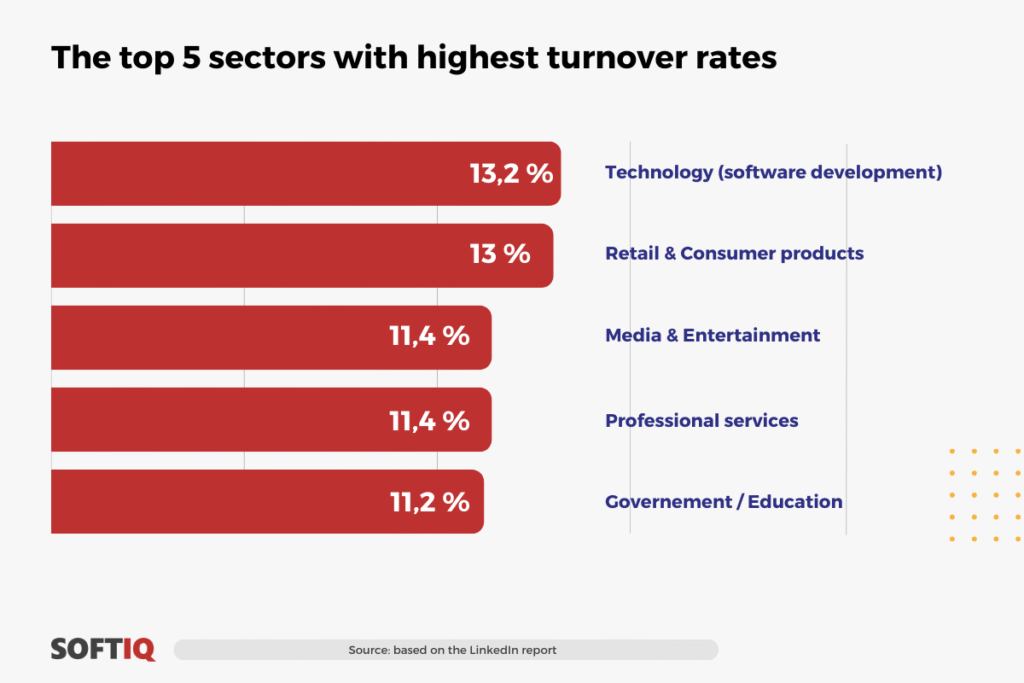
This means that for years the IT market is intensely competitive and dozens of industry-leading tech companies compete for fresh talent. In the technology sector, growing demand for software developers and competitive salaries fuel employee turnover.
How high could be revenue loss due to high employee turnover?
According to Work Institute, the cost of employee turnover is around 33% of an employee’s salary.
Devskiller estimates that you need around a month and a half, 43 days to hire a new software developer. This can cost you approximately $33,251 apart from the onboarding costs.
Add to that the time it takes you to bring the new employee up to speed. This might create bottlenecks, as your best employees take on some of the extra work.
If you are looking for a trusted partner, a software house able to deliver a stable team for your project, feel free to contact our consultants who will be able to prepare an individual offer for your company.

Why do employees leave tech companies?
According to ICONIC’s future of work report:
- 83% of tech employees leave due to dissatisfaction with the job role,
- 78% leave due to dissatisfaction with career growth and professional development,
- 75% leave due to salary or compensation reasons,
- while 73% leave due to burnout.
Here are some other data, from a survey by TalentLMS and Workable:
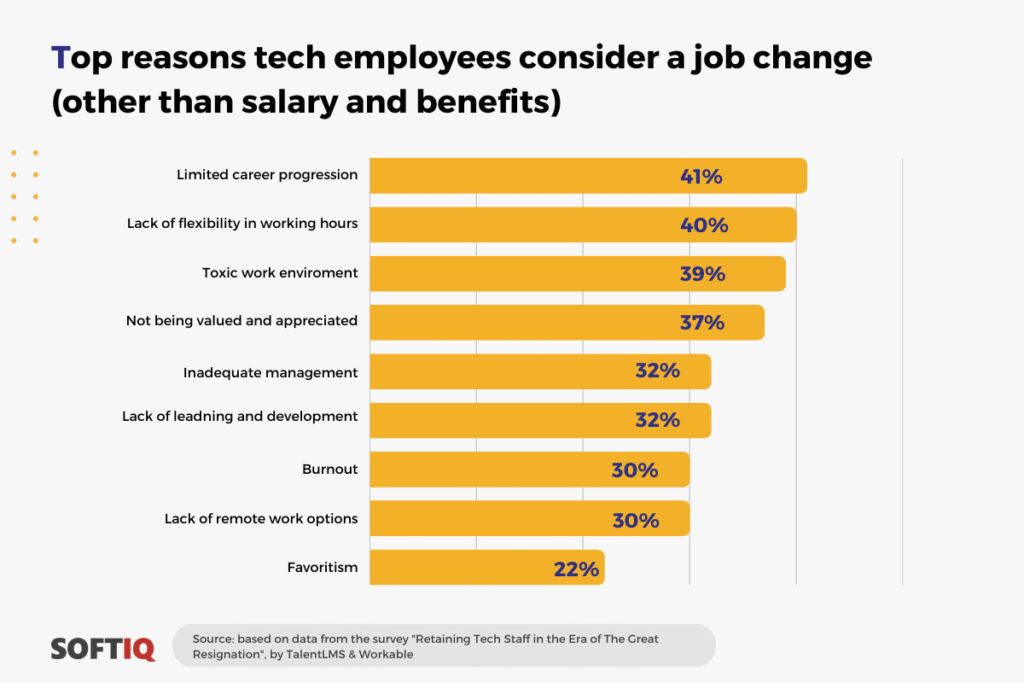
What is a healthy employee turnover rate?
At this point, it is important to understand what employee turnover rates are healthy for an organization. When an employee leaves a company, it is often viewed as something disruptive.
IT outsourcing companies need some amount of employee turnover to ensure a high level of motivation, generation of fresh ideas, and best practices that will help a company to prosper. So what is a happy medium? When is it time to beat the alarm?
According to Business.com data, 10% is the normal turnover rate each business should aim for. But there is no optimal number for a healthy employee turnover rate, it can vary from 10% to 25%, depending on the industry, key competitors, and market dynamics.
It also matters who is leaving a company: top performers or low performers. In fact, each company should strive to achieve a zero turnover rate among top performers because they are a valuable business asset. On the other hand, if your turnover rate correlates with the percentage of employees who don’t meet your expectations, this is a good indicator of your business’s success. The replacement of low performers can be healthy for an organization, enabling you to focus on hiring better talent.
The strategies IT outsourcing companies adopt to retain talent on example of SOFTIQ
Reducing turnover rates among employees in IT outsourcing companies is possible only if there is the alignment of an offshore and an on-site team. What’s more, there should be a robust strategy established in a company, including mentorship, regular performance reviews, real-time feedback, and a clear career advancement roadmap.
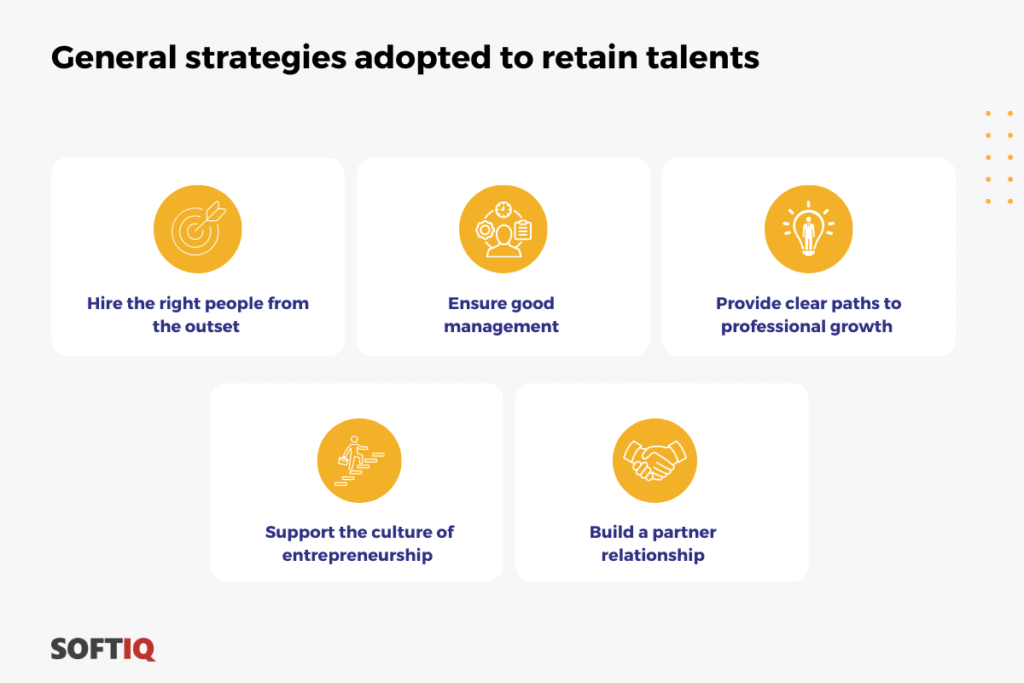
Here are some of the general strategies that IT outsourcing companies adopt to retain talents:
1. Hire the right people from the outset
No doubt, employee retention starts with recruitment. To gather a strong dedicated development team, recruiters should pay attention not only to the technical skills and previous experience of a candidate but also to a number of other aspects. For instance, customers often require specialists with knowledge in their domain. Also, the person should be a good cultural fit not only for the software house but for the Client’s company as well.
2. Ensure good management
Today efficient managers are mentors who open doors to learning opportunities and challenging tasks. Outsourced teams are usually managed by both sides – the Client and the provider. So it is important to have consistent delivery and management processes.
The software house needs to ensure full alignment of the outsourced team and the in-house one. A manager on the vendor’s side must study coding practices, communication channels, corporate ethics, and approaches to management in the Client’s company to build processes in the offshore location accordingly.
Only then outsourced development team be able to work effectively and enjoy their work. And this will lead to a high employee retention rate on the project.
3. Provide clear paths to professional growth
Competition for tech talent is huge, so it is quite costly to lose employees. Therefore, IT outsourcing companies understand how important it is to encourage the professional development of each employee in order to keep them happy and challenged in their roles.
IT companies use a number of practices to retain and grow employees, such as Individual Development Plans (IDP), Performance Appraisal (PA), career planning, salary reviews, and others.
4. Support the culture of entrepreneurship
By creating an environment for creativity, new ideas, risk-taking, and ownership, employers give their people everything they need to advance in their careers.
Empower your employees, encourage them to speak up, and drive new initiatives they are passionate about – and they will stay loyal to your company.
5. Build a partner relationship
Retaining employees is a joint work of both sides – an outsourcing vendor and a Client. It doesn’t matter how great the manager and the company are, if there is no well-established partnership between a Client and a team, an employee will look for better projects elsewhere, even within the same company.
One of the things that employees value most is the recognition and appreciation of their work. IT outsourcing companies encourage employees’ development and invest in their education. It is important that Clients embrace this initiative and also value the professional growth of their outsourced developers.
Here are a few things that work for us at SOFTIQ and help us in building stable developer teams for all types of projects:
In SOFTIQ, retention starts at the beginning of the recruitment process for each of our positions. The appropriate application selection process and selection of the best candidates in our opinion is the basis for employing the right people and retaining them as long as possible.
The most important aspect for us is the candidate’s employment history – the number of previous employers and the length of employment in previous workplaces vs. the candidate’s age or time of professional activity.
During recruitment, we try to find out the reasons for leaving, and the candidate’s attitude towards former employers, we pay attention to the way he talks about previous jobs. In addition, we get to know the candidate from the moment of exchanging the first sentences, which allows us to identify whether the company’s values and vision will be consistent with those on which the candidate is based and whether the team with which he would potentially work will be suitable for him. If the above is largely inconsistent, the chance for long-term cooperation will be small.
Other important aspects are:
1. Pre-onboarding and Onboarding – we take care of constant contact with the new employee before the first day of work at SOFTIQ. We provide the most important information through e.g. a dedicated “softiq handbook” in which we describe in detail the course of the first day of work. Bearing in mind the fact that the change of job is almost always accompanied by great stress, we try to minimize it at every stage of the employment process. Onboarding training is the responsibility of a designated person who welcomes and looks after new hires from the start. He is his „buddy” for the first few months. In this way, we want to show how important the new employee is to us.
2. Feedback – we support the culture of feedback and encourage you to give it. Used regularly, it ensures effective communication both in project teams and throughout the company. Thanks to constructive feedback, we can quickly respond to emerging problems. We care about the opinion of our employees, and we try to take every suggestion into account. After all, we create SoftiqTeam together. Additionally, we understand that one of the things that employees value is recognition and appreciation of their work.
3. Personal growth and training paths – we know how important development is for our employees, which is why we carefully analyze their training needs, involving direct superiors in this process. In consultation with the superiors, the HR department makes every effort to ensure that the training is best suited to the needs of employees – this is a key issue for us!
4. Remote, hybrid, and stationary work – we give you the choice. We build partner relations based on trust and cooperation, which is why our employees decide which form of work is more effective and convenient for them.
5. The atmosphere at work is very important to us and we take special care of it. We organize integration meetings, undertake charity activities together, and develop our interests. Because we have various passions, we join forces and spend time together also after work. Our canoeists, sailors, conquerors of mountain peaks, cyclists, and football players never get bored. In addition, we have many other thematic groups in which we share experiences, information, and support that are important to us.
We build partnership relations with employees. We listen to everyone, we respect opinions and views. We help each other. Regardless of the position we hold, we are open to dialogue. We trust our associates.
If you are looking for a trusted partner, a software house able to deliver a stable team for your project, feel free to contact our consultants who will be able to prepare an individual offer for your company.