

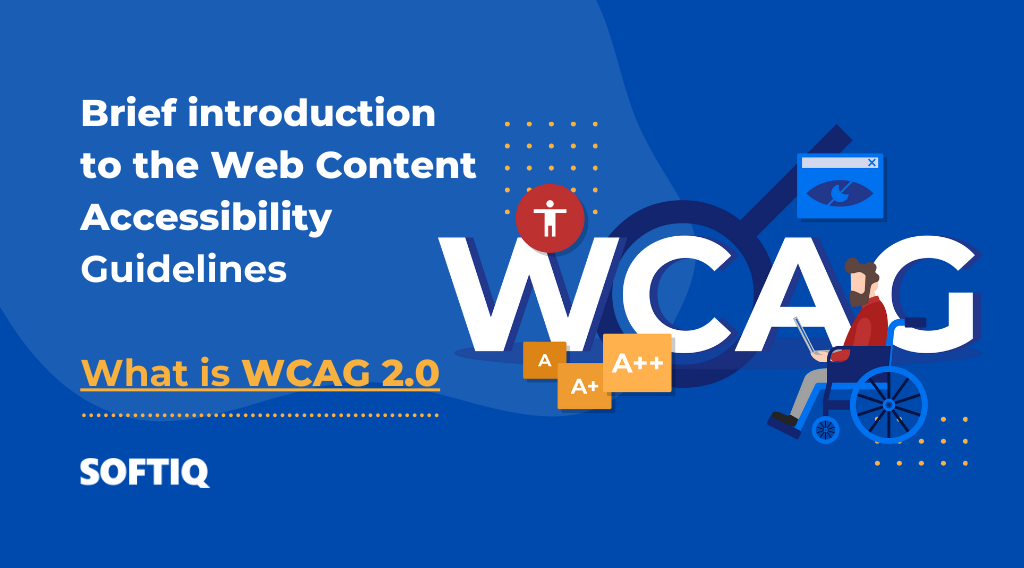
What is the WCAG 2.0 Standard?
The Web Content Accessibility Guidelines (WCAG) 2.0 are a set of recommendations for making web content more accessible to people with disabilities. Developed through the World Wide Web Consortium (W3C), specifically by the Web Accessibility Initiative (WAI), these guidelines aim to ensure that the web is an inclusive space for all users, including those with auditory, cognitive, neurological, physical, speech, and visual disabilities.
In 1999 the Web Accessibility Initiative, a project by the World Wide Web Consortium (W3C), published the Web Content Accessibility Guidelines WCAG 1.0.
WCAG 2.0 was published on December 11, 2008, and it builds upon the principles established in WCAG 1.0, refining and extending the guidance for web content accessibility. The guidelines are organized around four main principles, often summarized by the acronym POUR:
1. Perceivable
Information and user interface components must be presented in ways that users can perceive. This means that users must be able to perceive the presented information (it can’t be invisible to all of their senses).
2. Operable
User interface components and navigation must be operable. This principle focuses on ensuring that users can interact with all controls and navigate the website effectively.
3. Understandable
Information and the operation of the user interface must be understandable. This means that users must be able to understand the information as well as how to operate the interface (the content or operation cannot be beyond their understanding).
4. Robust
Content must be robust enough that it can be interpreted reliably by a wide variety of user agents, including assistive technologies. This principle ensures compatibility with current and future user tools.

WCAG 2.0 is structured around these principles and provides specific guidelines and success criteria at three levels of conformance: A (lowest), AA, and AAA (highest). Most organizations aim to meet at least Level AA conformance to ensure a broad level of accessibility for their web content.
Would you like to know more? Have a look at the following sources:
- World Wide Web Consortium (W3C)
- Web Accessibility Initiative (WAI)
- European Commission Web Accessibility Directive [Directive (EU) 2016/2102]