
The tourism and hotel industry is becoming increasingly dependent on modern information technology to manage reservations, process payments, and store customer data. Unfortunately, technology dependence has made the industry an attractive target for cybercriminals.
According to data published by IBM in the „Annual Cost of Data Breach” report, the average cost of a data breach in 2022 for the travel industry was USD 2.94 million.
The way your hotel secures customer data will be crucial not only in terms of limiting financial losses but also in terms of image loss – Guests can only trust companies that care about their privacy.
We have prepared a checklist for you to download, including the 10 most important actions that your company should plan and implement to protect itself against cyber criminals.
If you want to use our experience in securing your hotel against cybercriminals, schedule a free consultation. We’ll tell you how to get started and assess how our team can help your company.
Why do hotels need to take better care of the security of their guests’ data?
Increasing the level of security of systems used by hotels is of key importance, allowing for more effective protection of their customer’s data, care for the company’s reputation, and avoidance of financial penalties.
In one of our articles on data security in the hotel industry, we cited an example of the consequences that affected one of the global hotel chains as a result of a breach of guest data security:
- a fine of USD 23.8 million imposed by the UK Information Commissioner’s Office (ICO) for neglecting obligations under the General Data Protection Regulation (GDPR),
- legal costs related to lawsuits filed against the company, both from affected clients and investors,
- potential compensation resulting from lawsuits estimated at up to USD 1.8 billion,
- a temporary drop in the value of the hotel group shares by 8.7% after the hack was announced in 2018.
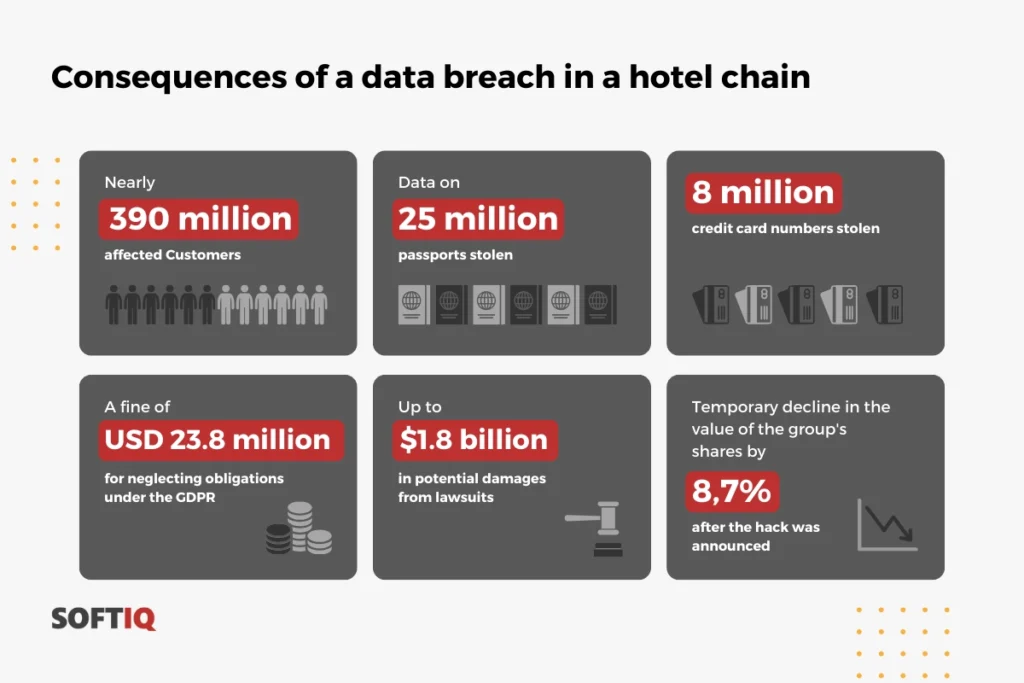
The scale of potential losses resulting from inadequate security of guest data perfectly illustrates why hotels and hotel chains should take better care of cybersecurity.
The most common data security threats in hotels
Hotels, like any other business, face many cybersecurity threats that can threaten their systems, data, and reputation. In their attacks, hackers use various methods to penetrate company systems.
The most common forms of attacks and threats encountered in hotels are:
1. Point of Sale (POS) Malware
Hackers often target hotel POS systems to steal sensitive information such as credit card numbers, names, addresses, and phone numbers. POS malware can be installed via infected software updates, phishing emails, or physical access to the system.
2. Ransomware
Ransomware attacks can encrypt hotel systems and data, requiring payment in exchange for the decryption key. If the hotel does not pay the ransom, your data may be lost forever.
3. Phishing attacks
Phishing attacks can be used to steal confidential information such as login credentials, financial information, or other sensitive data. Hotels need to be wary of emails that appear to come from legitimate sources but are phishing scams.
4. Distributed Denial of Service (DDoS) attacks
DDoS attacks can flood hotel systems with traffic, making access to networks or systems difficult or impossible. This can result in significant downtime and loss of revenue.
5. Internal threats
Insider threats may come from current or former employees, contractors, or others with authorized access to hotel systems. These threats may include intentional or unintentional data breaches, theft, or corruption of systems.
These are only the most common, but not all, types of threats against which systems used in hotels must be protected. More information about different types of attacks, along with examples from the hotel and tourism industry, can be found in our article: „A Closer Look at the 8 Top Cyber Attacks on Travel Booking Apps”
Cybersecurity checklist for your hotels and hotel chains
Cyberattacks can disrupt hotel operations, leading to loss of productivity and revenue. Securing systems from hackers can ensure that hotels can continue to provide services to guests, limiting the scale of potential losses.
How can you ensure data security in your company?
1. Designate employees responsible for cybersecurity and data privacy
Taking care of data security in the hotel company should be the responsibility of each employee. However, we know from experience that much better results in this area can be achieved when the team’s efforts are directed by properly trained leaders.
2. Identify and assess the level of risk for all data processed
Conducting a data security audit in your company should not only be a starting point but also a regular practice.
The risk assessment should take into account all systems through which your hotel obtains and processes customer data, as well as your staff.
It is especially worth paying attention to older software, applicable procedures, level of staff training (including seasonal employees), proper storage of system passwords, as well as security of software provided by your business partners (e.g. booking platforms).
3. Determine which systems are crucial for your company and start improving security there
To choose the right solutions, you need to know which systems need to be better secured. Only this way you can define priorities, prepare a recovery plan, and implement it with maximum efficiency.
4. Reduce the risk of data theft by properly managing access levels to systems
People are still the weakest link when it comes to securing data in a hotel. Make sure you consciously control who has access to what information in your company. This way, each employee will only see what is necessary to fulfill their duties, and if any of them are manipulated by cyber criminals, the scale of losses will be significantly limited.
5. Monitor your systems on an ongoing basis to quickly detect possible breaches
Many well-known breaches into hotel chain systems took months, and sometimes years, before they were detected. By properly monitoring user activity and the actions they take in your systems, you can detect and respond to an incident early enough. Thanks to this, the scale of losses will be much smaller.
6. Ensure that your systems are protected against malware
Hackers are becoming more and more creative when it comes to creating malware, so a simple antivirus is no longer enough. Invest in a properly developed and regularly updated solution to protect your systems against malware. Also, make sure that the tool you purchase will be properly configured.
7. Remember to protect your endpoints
Endpoints are physical devices that connect to the network (e.g. mobile devices, desktop computers, and laptops). They are a common target for cybercriminals because their weaker security is easier to break and allows them to get deeper into your company’s systems. Don’t just focus on reservation management software, but also ensure the security of the devices your staff uses.
8. Keep legacy systems and third-party software secure
At today’s pace of technology development, the security of your systems may be outdated just a few months after implementation. For this reason, ensuring appropriate updates should be particularly important to you.
This is also important for your partners’ and suppliers’ software if it connects to your systems. Poorly secured, it can then be used as an attack point against your company.
9. Educate your staff and be prepared in case of incidents
Building awareness of threats and what to do in the event of a problem within your team is crucial.
Employees should know the most common attack methods, how to counteract them, and what to do when they detect a system intrusion.
A quick response time and appropriate response in the event of an attack will significantly reduce image and financial losses.
10. Regularly test and improve your security
Only a reliable assessment of the current level of security guarantees that your sense of security will not be false.
Protecting your guests’ data is not a one-time initiative, but a long-term process. Thanks to regular security audits and penetration tests, you can be sure that your security measures are adequate to the level of threat.
Summary
Hotels and other tourism businesses rely heavily on technology to manage their operations, communicate with guests, and store sensitive information. However, this increased reliance on technology also exposes them to several cybersecurity threats.
While hotels can implement basic security measures on their own, achieving a high level of security without expert help can be a challenge.
Cooperating with software house specialists, such as the SOFTIQ team, will not only allow you to reliably verify the current level of security. We can also support you with periodic security tests, including penetration testing, as well as staff training.
If you want to be sure that you will make the best use of your funds to ensure data security, contact us and arrange a free consultation with our expert.
We will help you assess which security aspects you should focus on first and how to plan further actions.
If you are looking for more information about data security and systems in the hotel industry, we encourage you to read other texts on our blog:
“How the hotel industry is targeted by cybercriminals. The 4 most serious data thefts in history”
“Creating a GDPR-Compliant Online Booking System for Your Business. Step-by-Step Guide”